My memoir is set for a good part in the South of Nigeria, amongst the Yoruba people and the melting pot of big city Lagos.
Nigeria is a former British colony and as such, the official language is English. But there are several local languages ( like Yoruba) which are spoken, as well as pidgin English and a good deal of slang. All of this adds tremendous richness to the sounds you hear on the street, the conversations I grew up with and the street lingo that one needs to adopt to fit in, to engage, to survive.
As I wrote my book, the dialogue that propels the plot forward was a combination of all of the above, spoken by distinct characters each with their own unique inflections and ways of speaking that leaned into these options in different ways. A question I asked myself consistently was how to present the dialogue in such a way to keep the story advancing, whilst bringing in the richness of the Nigerian culture that formed the backdrop of my story.
I’ve seen many options in books over the years:
- No use of any other lingua franca or slang, essentially converting all dialogue to the best form of English translation.
- Using foreign languages or slang and finding ways within the narrative to offer a translation, often via repetition. For example. “Hola Amigo,” he started, “Hello my friend.”
- Using asterisked foreign language in the body of the text, followed by a footnote at the bottom of the page with the translation.
- Using untranslated foreign language in the body of the text and including a glossary as an appendix at the back of the book.
- Using foreign language in the text with no translation anywhere in the book.
As I reflected on these options, I really hated option (1). This feels like a sell out. Attempting to anglicize everything feels almost apologetic, like using traditional language is somehow “less than”, something to be covered up with Englishness. That would not do.
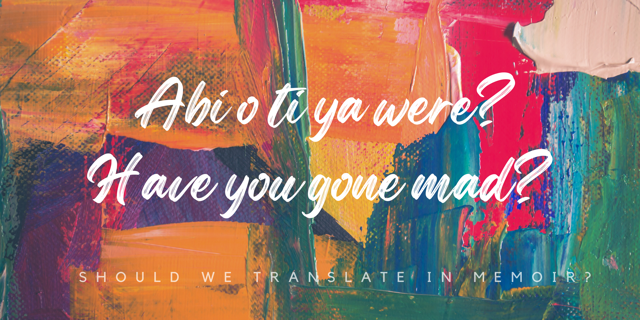
Option (2) seemed like an option that could work for some exchanges but not all. Interestingly, in Nigeria it is pretty common for people to start a sentence in a local language like Yoruba and finish in English or vice versa. Indeed, my father often would say something in Yoruba and for emphasis, would repeat it in English. “Abi o ti ya were?, have you gone mad?”. So I used this tactic for some limited dialogue.
Option (3) was not an option for me. I HATE it when authors do this in literary work. I find it too academic, like I’m reading a university thesis or an academic journal article. I also feel like it takes you out of the narrative.
I really wanted to go with option (5)… indeed many Nigerian authors do this. Adichie does not translate and as far as I remember does not offer a glossary. My writing coach talked me out of this and into option (4) – including a glossary for those readers who may want the extra info.
With option (4), the narrative is not interrupted or dumbed down by imperfect translation, she insisted however, some readers- curious readers, should be allowed the satisfaction of the additional info provided via a glossary.
So, option (4) is what I’ve gone with.
What are your thoughts? What options have you deployed in your writing?
 Novice Memoirist
Leave a comment