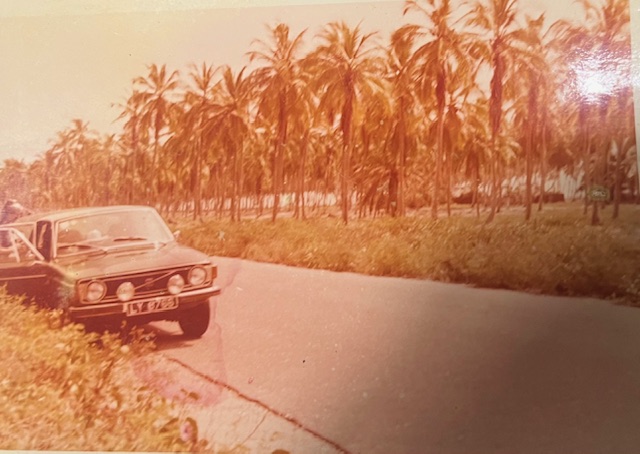
When I began to write my memoir, Oduduwa Crescent, I wanted Nigeria, the setting and landscape of the book, to be as well-drawn as any character. My book is, in its essence, the story of my charismatic father, whose rise and fall is set against the tumultuous backdrop of post-colonial Nigeria – a time of coup d’états, corruption, and rampant greed.
To that end, Nigeria is a critical character in my story -it is both the backdrop to my father’s story AND a crucial factor contributing to my father’s demise.
Much of the book is set in the chaotic metropolis of Lagos – a city of extreme contrasts, where wealth and abject poverty reside side by side. The time period I cover spans the pre-colonial era of the 1950s, the excesses of the oil-boom in the 1970s after independence, followed by the crippling economic decline of the 1980s, 1990s and 2000s brought on by militarisation and endemic corruption.
I weave Nigeria into the narrative of every chapter through the description of the setting as well as what characters see on TV, read in the newspapers, and hear on the radio.
Here are some examples:
Setting Description:
Government Residential Area (GRA) in Ikeja, where we moved to in the late 1970s, was one of the sleepy, leafy, Lagos suburbs of detached houses and patchwork gardens—an eclectic mix of old colonials, still inhabited by a large British expat community, and other modern constructions walled in by high concrete walls or electrified fences. Neatly kept gardens burst with bougainvillea, hibiscus and frangipani—the vibrant oranges, yellows and purples blending into a perfect watercolor. It was a vast residential neighborhood that crept as far as the railway line that divided it from the bedlam of Shogunle and the Lagos Airport beyond.
At the other end of the spectrum, far away from our orderly suburb, huge shanty towns and ghettos sprung up in places like Agege, Makoko and Ajegunle, built on marshland, swamp or close to industrial sites. Haphazard rows of shacks, fashioned from corrugated iron, wood and thatch and precariously balancing on stilts, rose out of the stinking, black water of the Lagos lagoon. These vast, makeshift communities housed the poor, the thousands of people who poured into Lagos daily, looking for work and a slice of the Lagos dream: fishermen, factory workers, drivers, domestic staff. Indigents also made their way down from the North and from all over West Africa to beg on the streets of Lagos. They came up to our car windows with their hands outstretched, hoping for change. They slept on mats and cardboard sheets under bridges and flyovers and in buildings under construction.
Political Climate Info via Radio:
My father darted into the bungalow that sat meekly behind a high wall, lined with broken glass—misshapen corpses of bottles of Fanta and Seven Up. A malam dressed in a white dashiki lounged by the gate, surrounded by coils of green mosquito repellent wires. He watched me suspiciously through red-ringed eyes, his jaw moving slowly left to right, as he chomped on a kola nut. A battered radio sat next to him, on which the news could be heard over a crackling sound.
“It has been seven long years and the country waits, poised, for a return to democracy, the hand over to civilian rule promised by Babangida, but will it actually happen?” I heard the news reporter say, her voice crisp and clear.
Political Climate info via newspaper:
The side door to the kitchen was open and I let myself in. The kitchen hummed and rattled from the sound of the old Kelvinator refrigerator that stood in the far corner, just about managing to belch out cold air, after being battered by years of power cuts and electrical surges. A solitary plate and glass sat unwashed in the sink, and a dank smell hung in the air, the smell of palm oil heated, then cooled, then reheated again.
Soggy discarded newspapers were strewn on the kitchen counter, used probably to drain surplus palm oil from yam or plantain, fried earlier that day. The headline: BOKO HARAM VIOLENCE jumped off the page from the newspaper closest to me, the font magnified in large letters. I paused to skim the broadsheet, taking in the harrowing pictures of a row of dead bodies, swaddled in white gauze, that had been recovered after a recent attack on a group of innocent Christians. The ongoing failure of Nigeria’s government to curb corruption, poverty and political abuse had fueled the violence of militant groups like Boko Haram. Since the end of military rule in 1999 and the years of unfulfilled promises of subsequent democratic governments, thousands of people had been killed in political, inter-communal and sectarian violence.
Shaking my head, I put down the paper then made my way through the house to look for my father, stifling a sneeze from the air filled with dust.
My book is ultimately the story of a daughter, her father, and their country—a land devastated by militarization and corrupted by avarice, and a people who will do anything to survive. I hope that readers can visualize Nigeria, can understand the context in which the story unfolds and are inspired to read on towards the end.
 Novice Memoirist
Leave a comment