I did it guys – I got signed by a literary agent!!!
When I posted my news on Instagram, I got lots of messages asking how I approached the process of finding an agent, so I thought I would capture some of my learnings in the hopes that they are helpful to others.
I started, as one does, by googling “how to find a literary agent” and was inundated with detailed information shared by others who have been on this journey: from blog posts, to podcast episodes, social media posts and YouTube vlogs – a minefield for sure.
In my usual way (thanks to years of working in corporate marketing), I put together a spreadsheet with my plan of action.
First off, I identified the various audiences that my book would appeal to:
1. Lovers of memoir
2. Lovers of memoir that confront family secrets
3. True crime enthusiasts (both fiction and non-fiction)
4. Readers who are interested in learning about different cultures
5. Readers of books by women of color
6. Fans of books and stories set in Nigeria
Second, from the above, I pulled together a list of comparative titles that hit the above audiences and began to research agents who have 1) expressed interest in any of the above and 2) have represented authors who have published books targeting these audiences.
Here were my go-to sources for agent information:
· USA agents: Publishers Marketplace, Writer’s Market
· UK agents: Writers & Artists Yearbook, Jericho Writers
· Agents of authors of comparative titles
· The Writer Files podcast
· #ManuscriptWishlist hashtag on twitter
· Personal recommendations
Third, I put together my query letter and book proposal which I must say was the HARDEST thing to do. How, for example, do you convey the essence of your book in 5 short paragraphs in a one-page query letter? All I can say is that I found it VERY HARD and as a result my query letter went through MANY MANY iterations, and I solicited lots of feedback from my writing coach and other writers. I also took a course at the Gotham Writers Workshop called “How to Get Published” taught by an NYC literary agent and covered all the essentials about writing a query letter and pitching to agents. I highly recommend it. Check it out here:
https://wp.writingclasses.com/courses/how-to-get-published
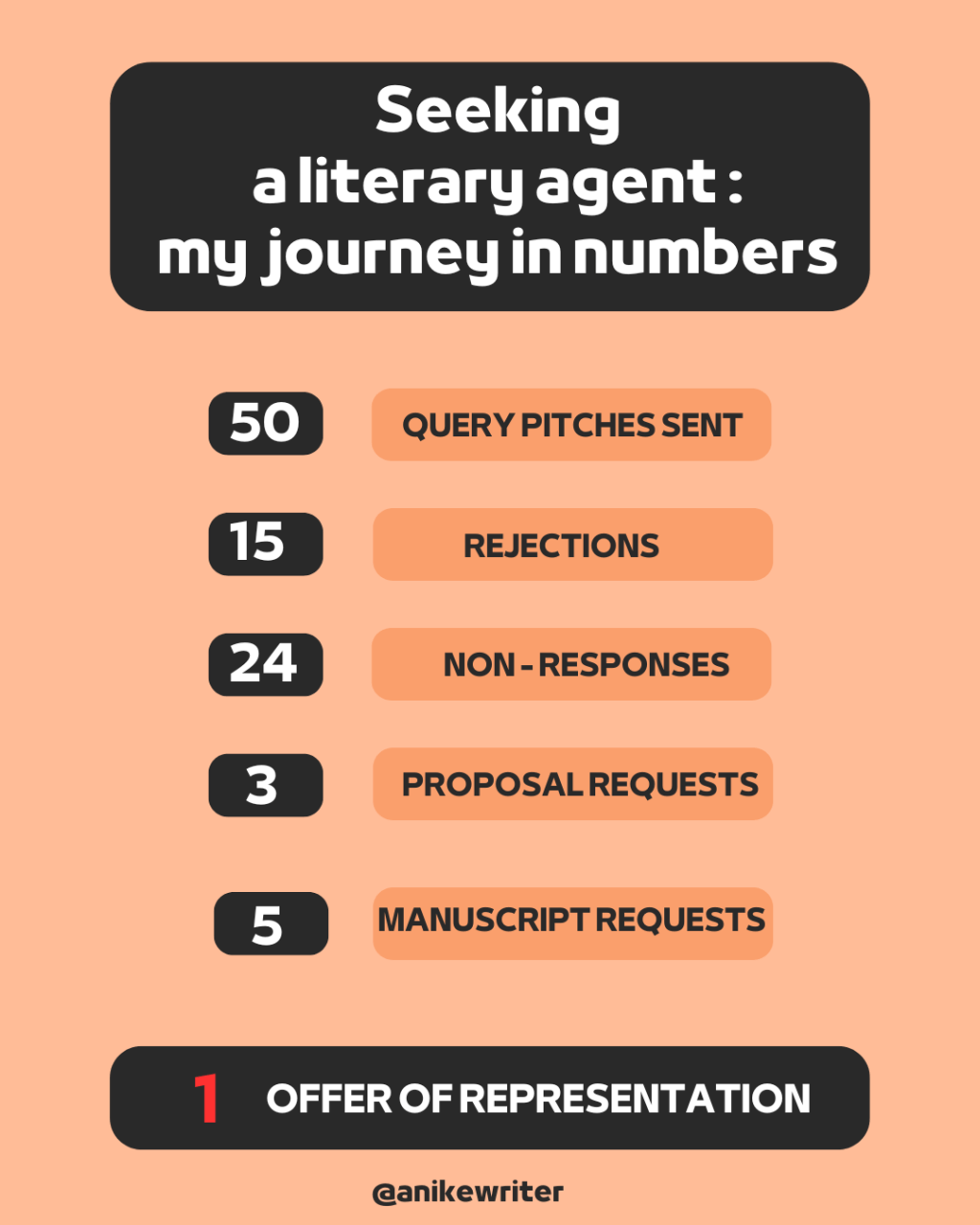
I started querying in October 2023 and for 7 months it was an absolute rollercoaster. Here are my numbers:
· 50 queries sent
· 15 rejections received
· 24 non-responses after defined period
· 3 book proposals requested
· 5 full manuscript requests
· 3 detailed feedback sessions
· 1 offer of representation
I signed my representation letter in April 2024.
Some of the rejections I received were form rejections with very minimal input. Ohers were gushing with praise and encouragement, yet others tinged with criticism. Some agents took the time to give feedback. One agent waxed lyrical about my writing style comparing me to a best-selling author she loved, yet still turned me down!
Here is a little sampling of some of the rejections:
[agent] enjoyed her read of ODUDUWA CRESCENT and thought your writing was lovely, but unfortunately, she doesn’t think she has the right vision to break this out in the marketplace the way it deserves.
I thought ODUDUWA CRESCENT was a wonderful book, and brilliantly written. But I’m afraid since we’ve emerged from the pandemic, memoir has become so very difficult to sell.
Thank you for the chance to review your work. Unfortunately, we are not the best fit for this piece at this time.
Our agents have now had a chance to look at it and we are sorry to say we don’t feel that we can offer you representation.
I thoroughly enjoyed reading your story. Your writing style is evocative, drawing the reader into the emotional turmoil experienced by the characters. Your story is captivating and is an emotionally charged journey to uncover ancestral pain. The narrative is rich in detail and emotion, offering a compelling reading experience. The way each chapter had a theme that included intricate details about your childhood, like when you caught your father’s confidence beginning to spill over into arrogance, was poetic. I could go on, but then this email would be very long. We believe that your story warrants further consideration.
Anike does write well. However, she should thoroughly revise her manuscript to eliminate, from my reading of only 3 chapters, superfluous detail and description. This may be difficult for Anike, as she is clearly emotionally invested in telling her story.
Oduduwa Crescent quickly became a team favorite. A number of us read it quickly, and with much enthusiasm. One person said, “this book deserves to be represented.” In reading your pages, I can see why: you have a gift with language and depicting emotion. The true crime aspect makes this a particularly compelling pitch.
I could go on, but I think you get the idea.
Every email I received sent me on a whirlwind of emotions. Receiving wonderful words of praise only to be told several days later that the agent had decided to pass, plunged me into days of melancholy. With each rejection I would question myself, question my writing ability and question the validity of the story that I was trying to tell. But after a bottle of wine and a good night’s sleep, I would send more queries out the following day, determined not to give up.
The day I got the call from my agent offering me representation, I lost my shit – literally. I called my husband screaming incoherently. That was a nice day.
So, what have I learned from this journey?
· Rejection is part of the journey. It is AWFUL, especially when you get rejection after rejection, but you have to keep going. Over my querying months I reminded myself of the number of rejections typically received by a debut author going through this process – apparently the average number is 60.
· Writing is a matter of interest and taste. Not every agent will be drawn to your story and that is ok. File away the rejection and move on.
· Having an idea about the salability of your genre is important. I knew off the bat that memoir is tough to sell, so I spent a lot of time coming up with comp titles that were not memoir.
· Agents have their lists, and sometimes they are looking to “complete” their list with a certain type of author writing in a particular genre. You may or may not be the missing piece of their puzzle.
· Finally, it’s ALL about the query letter – you must get this RIGHT! Get lots of feedback, read lots of example query letters and fine tune that baby till it sings.
Querying is the shittiest process ever, but it must be done if you want an agent to represent you. I guess in many ways it prepares you for the real deal – pitching your book to publishers which will also undoubtedly come with its own rollercoaster of emotions. I am bracing myself for that.
I hope the above was in some way helpful. Wishing us all luck as we navigate this crazy journey of trying to get published.
 Novice Memoirist
Leave a comment